
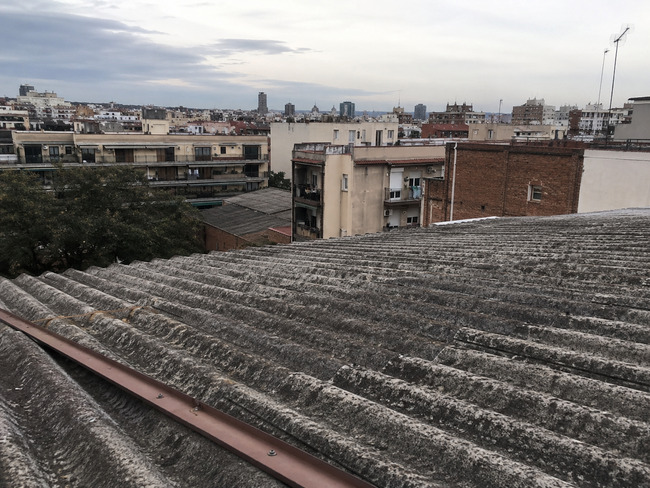
Every time I visit a flat awaiting restoration in Barcelona from the first half of the 20th century, or a 1970s industrial unit out in the Vallès, I know what I’ll find hidden behind partition walls or up on the roof: asbestos-cement downpipes that surface once the demolition starts, or those grey corrugated sheets (that grey so characteristic of asbestos cement).
In Catalonia, asbestos was used in construction right up until 2002, so any renovation of a building from before then runs into it sooner or later. It’s not just a cosmetic problem: handled badly, it releases fibres that are dangerous to anyone living or working in the building, which is why removing it is never an optional extra.
The good news: since 2019 the Generalitat has been funding its removal, with grants that can cover 100% of the cost. The less good news: the 2026 call has already closed, 2 July at 2 p.m. If you’ve landed here looking to apply right now, I’ll be straight with you: this round is no longer open. But keep reading, because the rest of this guide, requirements, amounts, documentation, and what to do while you wait for the next call, is still exactly what you need.
Current status of the asbestos call in Catalonia
The 2026 call was approved through Resolution TER/1743/2026 of 28 May (DOGC no. 9687), based on the regulatory framework of Resolution TER/1547/2026 of 18 May (DOGC no. 9670). The application window was open from 18 June at 9 a.m. to 2 July 2026 at 2 p.m., managed by the Catalan Waste Agency (Agència de Residus de Catalunya, ARC). You can review the full procedure on Gencat to see the complete history.
As of today, it’s closed. For now there’s no official date for the next call. If anyone gives you one, be sceptical: not even the Generalitat itself has published it yet.
What we do know is that this has repeated almost every year since 2019, so it will come back. And when it does, whoever has their paperwork ready in advance gets there ahead of whoever starts hunting for it on the day.
When will the next call open?
I’m not going to invent a date here. Nobody has one yet. But the track record does tell us something interesting.
How the timetable has varied in previous calls
The length of the window varies enormously from one year to the next, something very few articles on the subject explain properly:
| Call | Opens | Closes | Duration |
|---|---|---|---|
| 2025 | 15 January | 28 November (or earlier, if the budget ran out) | Over 10 months |
| 2026 (general line) | 18 June | 2 July | 2 weeks |
| 2026 (storm-damage line) | 20 January | One month after publication | Approx. 1 month |
Did you know the 2026 call was open for just 15 days, against the 10-plus months of the 2025 one? That gives you a sense of how unpredictable the timetable is, and of why preparing your documentation in advance matters as much as it seems to.
In the meantime: prepare your documentation, don’t wait for the opening
These grants are awarded in order of application, not by lottery or scoring. It’s what’s known as non-competitive public concurrence: the first correct applications to come in are the first to get paid, until the allocated budget runs out. Someone who turns up on day 3 with half their paperwork done has probably already missed out, even if they’re fully entitled to the grant.
At Nomadas we work this way with our clients: if we know there’s an asbestos-cement roof in the project, we get the technical report and the rest of the documentation ready well before the call is announced. On opening day, all that’s left is to submit.
We analyze the feasibility of your idea, answer your initial questions, and guide you through the first steps with no obligation.
There are two separate grant lines: don’t mix them up
Something almost no article on this topic clears up: there are two different calls for asbestos in Catalonia. Here they are:
General asbestos-removal line
This is the one we’ve described so far: any owner of any property containing asbestos can apply within the window the ARC sets each year.
Specific line for damage from exceptional weather events
There’s a second line, smaller and more occasional, for asbestos-cement roofs damaged by hailstorms or storms officially declared by the Catalan Meteorological Service (Servei Meteorològic de Catalunya). The 2026 one (Resolution TER/188/2026) opened on 20 January for damage in the Ripollès, the Garrotxa, and l’Alt Urgell, with a one-month window.
If your roof was broken by a specific storm, don’t wait for the general call: this line is activated as weather events are declared, and it tends to move faster.
How much does the grant cover?
The amount depends on the square metres of asbestos to be removed, capped at €30,000 per property:
| Surface area | Amount |
|---|---|
| Up to 49.99 m² | €2,000 (flat amount) |
| 50 to 99.99 m² | €40/m² |
| 100 to 499.99 m² | €30/m² |
| 500 to 999.99 m² | €25/m² |
| 1,000 m² and above | €20/m² |
For non-roof elements (tanks, downpipes, gutters), the ARC provides an official spreadsheet to convert linear metres or volume into equivalent square metres.
What the grant covers and what it doesn’t
The 2026 call had one particular feature compared with previous years: it covered any type of asbestos waste, not just roofs. Specifically:
- Dismantling and removal of the asbestos element (roof, downpipe, tank, gutter, façade).
- Transport of the waste to an authorised waste manager.
- Treatment of the waste at approved facilities.
What it never covers:
- The new materials that replace the removed asbestos (the tiles, the sandwich panel, or the new roof are on you).
- VAT, where the beneficiary can deduct it.
Who can apply for the grant?
Any owner of a property containing asbestos in Catalonia can apply, whether:
- An individual, using a digital certificate or idCat Mòbil.
- A residents’ association, with prior agreement from the owners’ meeting.
- A company or self-employed person, owning an industrial unit, business premises, or home containing asbestos.
- A public body, applying through EACAT.
Requirements to qualify for the grant
- The removal must be carried out by a company registered with RERA (the Register of Companies with Asbestos Risk). Not just any builder will do: it has to be listed in that specific register.
- The application must be submitted before the work begins. The cost is only eligible from the application date onwards, never before.
- You must be up to date with your tax obligations to the Generalitat and to Social Security.
Documentation you need to apply
This is the part that makes the difference between submitting on day 1 and being shut out by a last-minute request for corrections. The documents the ARC asks for are:
- Descriptive report, with the property details, the asbestos elements, and the RERA company that will do the work.
- Annex 1, with the screen capture from the ICGC’s VISSIR viewer and the surface area in square metres (only if there’s a roof; for other elements, the location is enough).
- Annex 2, with general and close-up photographs of the element to be removed. If the roof is double-layered, photos of both the front and the back are required.
- Proof of ownership of the property: the title deed, a land registry extract (nota simple), or a certificate of ownership and encumbrances.
- The owners’ meeting agreement, if the applicant is a residents’ association.
- And, of course, the quote from the RERA company, with the square metres broken down consistently with the report and the annexes.
How to apply for the grant, step by step
- Request a quote from a RERA-registered company, with the report and annexes filled in as far as possible.
- Check that the square metres match across the report, Annex 1, and the quote. This is the most common error and the one that generates the most requests for corrections.
- Submit the application on opening day itself, identifying yourself with a digital certificate, idCat Mòbil, or the appropriate system if you’re a legal entity.
- Wait for the decision. The ARC usually decides within a window of a few weeks to several months; in previous calls the list of beneficiaries has been published around 3–6 months after the window closed, though this isn’t a fixed timeframe.
- Carry out the removal once you have a favourable decision, always with the RERA company named in the application.
- Justify the expense with the final invoice to receive payment.
We analyze the feasibility of your idea, answer your initial questions, and guide you through the first steps with no obligation.
Is it compatible with other renovation grants?
Yes, and this is something many owners write off without checking. This grant is compatible with other public or private aid, such as full-renovation schemes or energy-efficiency funds, as long as the combined total doesn’t exceed the actual cost of the work.
But look closer and there’s an important caveat: it’s subject to the de minimis regime (Regulation (EU) 2023/2831), which limits the total public aid that any one person or company can receive over a given period.
This has a direct implication if you’re planning a full renovation: asbestos removal and the rest of the work can go hand in hand, but it’s worth reviewing the de minimis ceilings before stacking several aid lines at once.
Frequently asked questions about asbestos grants in Catalonia
Can I file the application on behalf of my parents, if they’re elderly and don’t have a digital certificate?
Yes, but you’ll need power of attorney. This can be a notarial power of attorney or, more conveniently, an “apud acta” representation through Representa.cat, where your parents verify their identity by video or in person, without needing their own idCat or digital certificate.
What happens if my application doesn’t get in on time, or the budget runs out?
You lose that call. There’s no waiting list or second chance within the same year: you’ll have to prepare your documentation and wait for the next one.
Can I remove the asbestos without waiting for a grant?
Yes, and in many cases it’s the sensible option if the roof is deteriorating or the renovation project can’t wait months. The removal must always be done by a RERA company, grant or no grant.
Does the decision take the same time every year?
There’s no fixed timeframe in law. Recent calls have been decided within a range of 3 to 6 months, but that’s a rough guide, not a guarantee.
Don’t want to wait for the next call? Remove the asbestos now
If you’re weighing up the renovation or refurbishment of a masia (traditional Catalan farmhouse), an industrial unit, or a 1960s or 1970s building in Catalonia, asbestos is almost certainly part of the equation, and removing it shapes your timeline, your budget, and, with a bit of luck, the grant too.
At Nomadas Architecture we run into this on a large share of the renovation projects that touch old roofs, so we factor it in from the very first site visit: we identify whether there’s asbestos, calculate the surface area, and get the documentation ready for when the next call opens, or handle the removal anyway if the window is closed.
Have you ever come across an asbestos or uralita (asbestos-cement) roof when buying or renovating a home?
Official sources consulted
- Official grant procedure on Gencat
- The Catalan Waste Agency’s asbestos grants page
- Resolution TER/1547/2026 of 18 May (DOGC no. 9670, 21/05/2026) and Resolution TER/1743/2026 of 28 May (DOGC no. 9687, 16/06/2026)
